ASU (Air Supply Units for air suspension) is
a core subsystem of automotive air suspension systems. By generating, storing,
and regulating compressed air, it enables dynamic control of suspension height,
stiffness, and damping, thereby improving vehicle comfort, handling, and
off-road capability.
Its main functions include: 1.Supplying stable high-pressure air to
support vehicle weight and adjust suspension travel; 2.Dynamically regulating air pressure
according to driving conditions; 3.Preventing abnormal states such as
overpressure, overheating, or air leakage to ensure system reliability.
Air source module: responsible for air pressure generation and storage. The air
compressor compresses ambient air to high pressure, operating on-demand with
built-in overload protection. The air tank stores high-pressure air to reduce
compressors recycling and stabilize air pressure output. The air dryer removes
moisture from compressed air to prevent freezing or corrosion during winter.
Control module: Handles signal processing and logic control. The ECU/TCU receives
sensor data, calculates target pressure and controls solenoid valve actions. It
implements closed-loop height control, stiffness adjustment, overpressure
relief (via safety valve), compressor thermal shutdown, and leak detection
alerts. The pressure regulator reduces high-pressure air from the air tank to
working pressure suitable for air springs, preventing damage from overpressure.
Actuation module: Manages air distribution and regulation. The solenoid valve set
directs air flow through inflation, deflation, and pressure-holding operations,
with individual solenoid valves for each air spring. Some vehicles include
mechanical lock valves that maintain pressure when powered off. Air lines.
Auxiliary components include: Safety Valve, Exhaust Muffler, Filters and filter elements,
which enhance system reliability and performance.
Working principle of the ASU Air Supply
System: Height sensors continuously monitor vehicle
posture, acceleration sensors detect road impact signals, pressure sensors
measure air tank pressure. The ECU integrates these data and driving modes to
form control strategies. Based on algorithms, it automatically inflates or
deflates air springs to maintain the vehicle at a preset height, ensuring
optimal working conditions for the air suspension. Example operations: Vehicle raising (inflation process): When
increased load lowers the body height, the sensors detect the drop, and the ECU
opens the solenoid valves to inflate the air springs. The rising pressure lifts
the vehicle until the target height is reached, then the valves close to
maintain the height. Vehicle lowering (deflation process): When
reduced load causes the body to rise, the ECU opens the valves to release air.
The pressure drop lowers the body until the desired height is reached, after
which the valves close. Air spring pressure directly affects
suspension stiffness: Higher pressure → firmer springs → better
handling Lower pressure → softer springs → better
ride comfort A closed-loop control algorithm (e.g., PID)
ensures height deviation stays within ±3 mm and minimizes compressor cycling to
extend system lifespan.
Technique features and advantages of the
Air Suspension Supply System: Active Adjustment & Dynamic Response: Real-time
monitoring via height and pressure sensors combined with ECU control enables
quick and precise adjustment of air pressure, ride height, and suspension
stiffness. Modular & Integrated Design: Core
components such as the compressor, air tank, solenoid valves, and sensors are
highly integrated for a compact layout, suitable for various vehicle platforms.
Lightweight materials ensure pressure resistance while reducing system weight
and improving energy efficiency. Stable Pressure & Safety Protection: The
air tank provides a stable pressure reserve, reducing compressor start/stop
frequency and extending component lifespan. Safety valves protect against
overpressure. Fault detection features (e.g., for air leaks, overheating, or
sensor failure) trigger automatic protection mechanisms and alerts.
Through “real-time sensing, intelligent
decision-making, and precise execution”, the ASU air suspension system enables
active control over ride height and suspension characteristics. Compared to
traditional suspension systems, it offers clear advantages in comfort, load
adaptability, and smart functionality.
HOLS Automation has years of expertise in
industrial automation, backed by a strong technical team and R&D capabilities.
The company offers intelligent manufacturing solutions for chassis suspension
systems, including: Automated Air Spring Dampers Production Line, Air
Suspension Supply System Assembly Line, Air compressor Assembly Line, Automated
Chassis Domain Controller Production Line, etc.
2. Different sizes of dispensing volume: Relatively speaking, the minimum dispensing volume of the dispensing machine is larger than that of the dispensing machine, and the maximum dispensing volume of the dispensing machine can reach more than ten to twenty grams per second, while the dispensing machine has a smaller dispensing volume. Some dispensing machines can achieve a minimum dispensing volume of 0.001g.
In the field of automotive engineering, the suspension system is a critical assembly connecting the vehicle body to the wheels. Its core functions are to buffer road impacts, dampen body vibrations, and maintain effective contact between the tires and the road surface. It has a decisive influence on ride comfort, handling stability, and safety. With the advancement of vehicle electrification and intelligence, Steer-by-Wire Suspension Systems capable of real-time active control are becoming a significant direction for technological evolution.
I. Technical Definition
A Steer-by-Wire Suspension System is, in essence, an active suspension system controlled via electronic signals. It utilizes a network of sensors to perceive vehicle status and road input, processes this data in real-time through a central controller, and drives electronically controlled actuators to dynamically adjust suspension parameters such as stiffness, damping, and height. This technological approach replaces the mechanical constraints of traditional passive suspension response, enabling precise management of the vehicle's vertical motion.
II. System Composition and Functions
The system primarily consists of three synergistic subsystems: perception, control, and execution.
The Perception System is composed of various sensors distributed throughout the body and chassis. These include displacement sensors for monitoring body height, inertial sensors for measuring longitudinal and lateral acceleration, wheel speed sensors for monitoring wheel motion status, among others. Some advanced systems also integrate optical or radar sensors to scan upcoming road conditions for predictive control.
The Control System centers around the Suspension Electronic Control Unit. It receives signal data from all sensors, performs high-speed calculations based on built-in control strategies and algorithmic models, determines the optimal adjustment parameters required for each wheel's suspension under current conditions, and then sends precise command signals to the respective actuators.
The Execution System is responsible for the physical realization of changes in suspension characteristics. It mainly includes the following key components:
Currently, integrated solutions combining air springs with continuously adjustable damping shock absorbers have become the mainstream application in the market due to their good balance between performance and cost.
III. Working Principle
The Steer-by-Wire Suspension System operates in a closed-loop control mode, following this workflow:
IV. Main Technical Characteristics
The application of Steer-by-Wire Suspension Systems brings improvements in multiple performance aspects:
V. Application Status and Challenges
Currently, Steer-by-Wire Suspension Systems, due to their significant performance advantages, are gradually being applied in some high-end vehicle models. However, their large-scale adoption still faces several practical challenges:
In the future, with the maturation of supply chains, advancements in control algorithms, and the push for large-scale production, costs are expected to gradually decrease, potentially expanding the application scope of this technology.
Conclusion
The Steer-by-Wire Suspension System represents the trend in suspension technology from passive mechanical systems towards active electronic control. By introducing real-time perception and closed-loop control, it significantly expands the performance boundaries of suspensions, serving as an effective technological solution for enhancing the overall dynamic quality of modern vehicles.
HOLS Automation specializes in providing automated solutions for the manufacturing of core automotive components. For the production of key components within Steer-by-Wire Suspension Systems, such as air springs, shock absorbers, and control units, we can provide high-precision, highly reliable assembly, inspection, and testing production lines to support the industrialization and quality assurance of this technology.
Today, as vehicle powertrains undergo a profound transformation towards electrification and intelligence, thermal management systems have evolved from a supporting role to a core system crucial for vehicle performance, safety, and range. Whether ensuring the efficient operation of the electric powertrain or achieving precise temperature control within the cabin, an agile and efficient thermal management circuit is paramount. The "heart" driving this circuit's circulation is rapidly evolving from the traditional mechanical water pump to the Automotive Electronic Coolant Pump. It is not only a standard feature in new energy vehicles but also a key actuator enabling the intelligent management and utilization of the vehicle's energy.
I. Core Definition: From "Mechanical Drive" to "Electronic Control & Intelligence"
An automotive electronic coolant pump is a cooling fluid circulation device that employs an independently driven motor and is precisely controlled by an Electronic Control Unit (ECU). It completely breaks free from the constraints of traditional mechanical pumps driven by the engine crankshaft via a belt, decoupling its speed entirely from engine RPM.
The speed of a traditional mechanical pump is fixed relative to engine speed, leading to insufficient coolant flow at low engine RPM (e.g., cold start, idle) and potential over-circulation at high RPM, resulting in energy waste and an inability to meet complex operational demands. The electronic pump achieves "on-demand supply": its built-in brushless permanent magnet motor receives commands from the vehicle's central controller and can independently and continuously adjust its speed from 0 to its maximum RPM, enabling precise, dynamic control over coolant flow rate.
In essence, the electronic pump transforms coolant circulation from a passive "mechanical task" into an active, intelligently regulated "thermal management process," serving as the "smart heart" of the intelligent vehicle's thermal management system.
II. Primary Functions: Enabling Precise Thermal Control in Multiple Scenarios
The "electronically controllable" nature of the electronic pump allows it to play a diversified and precise critical role in new vehicle architectures:
III. Working Process and Principle: Intelligent Closed-Loop Control
The operation of an electronic pump is a classic closed-loop process of "perception-decision-execution-optimization," with its intelligence embedded throughout:
IV. Key Technical Advantages
Compared to traditional mechanical pumps, the technical advantages of electronic pumps are comprehensive:
V. Development Trends and Challenges
In the future, automotive electronic coolant pumps will develop towards higher power density, lower energy consumption, deeper system integration, and intelligent diagnostics. For example, "smart pumps" deeply integrated with controllers will enable self-monitoring and fault预警. Concurrently, with the proliferation of 800V high-voltage platforms and ultra-fast charging technology, more stringent challenges are posed regarding the pump's high-voltage resistance, high flow rate, and ultra-high reliability, placing continuous pressure on the upgrading of its design and manufacturing processes.
Conclusion
The widespread adoption of automotive electronic coolant pumps is a core indicator of the evolution of vehicle thermal management systems from "passive adaptation" to "active planning and precise execution." As the "core actuator" within the intelligent thermal management network, its performance directly determines the potential of the electric powertrain, the vehicle's overall energy utilization efficiency, and the user's comfort experience.
HOLS Automation has deep expertise in the intelligent manufacturing of core components for smart chassis and electric powertrain systems. We thoroughly understand the extreme requirements for production consistency, sealing tests, and functional validation of high-reliability mechatronic products like electronic coolant pumps. We provide industry clients with comprehensive, highly flexible automated production line solutions for electronic pumps. These cover the entire process from the automated assembly and precision press-fitting of core components (e.g., impeller, pump housing) to final assembly stages including leak testing, performance testing (flow-head-power curves), electronic control function flashing, and final inspection. We are committed to leveraging our advanced non-standard customization capabilities and rigorous process management to assist clients in achieving high-quality, efficient production, jointly promoting the reliable evolution of core components for new energy vehicles.
At the heart of precision equipment and
automated systems lies a mechanical component that converts rotary power into
linear motion with minimal loss and high precision—the Ball Screw.
It serves not only as the "precision tendon" for CNC machine tools,
industrial robots, semiconductor equipment, and even intelligent automotive
steering systems but also stands as a key indicator of a nation's fundamental
manufacturing capabilities for high-end equipment. Its performance directly
determines a machine's positioning accuracy, motion speed, and long-term
reliability. This article will systematically elaborate on the technical
principles of the ball screw as the core of mechanical transmission and provide
an in-depth analysis of its main classifications and application
characteristics.
I. Core Value and Technical Principle:
Transforming Sliding into Rolling
The core value of the ball screw stems from
its revolutionary working principle: replacing traditional sliding
friction with rolling friction. This fundamental change overcomes the
inherent drawbacks of sliding transmission methods, such as lead screws, which
suffer from low efficiency, rapid wear, and difficulty maintaining accuracy.
A complete ball screw assembly consists of
three basic components: the Screw Shaft, the Nut, and the Recirculating
Balls. The screw shaft features a precision-ground or rolled helical
raceway on its surface, while the paired nut contains a corresponding internal
reverse raceway. A multitude of high-precision balls are contained within the
sealed space formed by these two raceways.
When a servo motor drives the Screw
Shaft to rotate, the balls are forced to roll within the raceways.
This rolling motion efficiently converts the rotational torque into axial
thrust, thereby driving the Nut to perform linear displacement
along the screw's axis. To enable continuous motion, the nut is designed with a
precise Recirculation Path (such as end-cap deflectors or
internal return tubes), which guides the balls from the end of the working
track back to the starting point, forming an infinitely looping "ball
chain."
This design delivers four core advantages:
II. Core Classification I: By
Manufacturing Process
Based on the method used to form the
threaded raceway, ball screws are primarily divided into two major categories,
with significant differences in performance, cost, and application scenarios.
1. Precision-Ground Ball Screws
Their threaded raceways are precision-ground to form using
high-accuracy thread grinding machines after precise heat treatment. This is
the manufacturing process that currently achieves the highest level of
accuracy.
2. Rolled (or Cold-Formed) Ball Screws
Their threaded raceways are processed using the precision cold-rolling forming
process. The screw blank is plastically deformed at room temperature by
specially designed rolling dies to form the thread profile.
III. Core Classification II: By Nut
Circulation Method
The method by which balls recirculate
within the nut is another critical dimension defining a ball screw's
performance characteristics, mainly divided into external recirculation and
internal recirculation.
1. External Recirculation Ball Screws
After completing one cycle, the balls return to the starting point via a return
tube mounted externally on the nut. This is the most common and
economical structural form.
2. Internal Recirculation Ball Screws
The ball recirculation is completed entirely inside the nut, achieved through
a deflector embedded in the nut wall that changes the ball's
direction and guides its return.
Furthermore, based on different preloading
methods (to eliminate backlash and increase rigidity), types include single-nut
double-lead preload and double-nut preload (back-to-back or
face-to-face), catering to varying requirements for rigidity and accuracy
stability.
IV. HOLS Automation's Understanding and
Solutions
The technical selection of a ball screw is
far more than a simple parameter comparison. It requires systematic engineering
trade-offs based on the equipment's dynamic performance targets, load
conditions, life expectancy, and cost control. Improper selection can, at best,
prevent the equipment from achieving its full performance potential and, at
worst, lead to premature failure, affecting overall machine reliability.
Through long-term service in the high-end
equipment manufacturing industry, HOLS Automation has
accumulated a profound knowledge base regarding the selection and application
of core transmission components. We deeply understand that correct ball screw
selection is the cornerstone for realizing equipment design intent, whether for
precision positioning modules in intelligent production lines or for
integration into high-dynamic-response testing equipment.
Our value lies not only in providing
customers with high-performance automated production line integration services
but also in our ability to engage from the initial design phase.
Leveraging our deep understanding of transmission technology, we assist
customers in the technical selection and verification of key motion components,
helping to mitigate potential technical risks. Concurrently, we possess the
capability to provide sub-production line solutions for the automated
assembly, inspection, and performance validation of these precision
transmission components, ensuring quality consistency from the manufacturing
end.
We believe that only by deeply
understanding fundamental core components like the ball screw can stable,
precise, and efficient top-tier equipment be constructed. HOLS Automation is
committed to leveraging our professional expertise in precision manufacturing
and automation to serve as the reliable support behind our customers' products'
superior performance.
In modern industries such as electronic communications, new energy vehicles, semiconductor packaging, and high-end industrial manufacturing, precise and reliable fluid dispensing and encapsulation technologies are critical for ensuring product performance, lifespan, and consistency. Whether it's protecting core circuits from environmental hazards or achieving secure bonding for structural components, the accurate control of adhesives has become an indispensable part of intelligent manufacturing. HOLS Automation, with its deep expertise in industrial automation, offers comprehensive Fluid Control and Bonding Technology Solutions. By integrating a profound understanding of fluid behavior with precision motion control technology, we provide solutions for the entire spectrum of applications, from micro-volume precision dispensing to high-volume automated potting.
I. Technological Core: Analysis and Application Distinction Between Potting and Dispensing
Fluid control equipment is primarily categorized into Potting Machines and Dispensing Machines. Understanding their fundamental differences is key to selecting the correct technological solution.
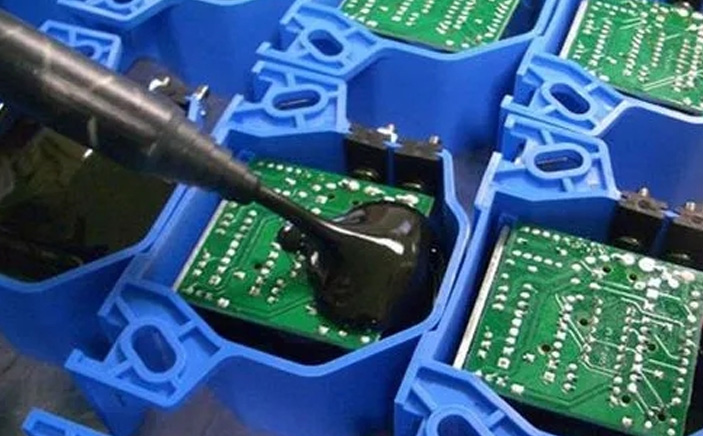
Potting Machines, specifically referring to AB Adhesive Potting Machines, are designed for the automated mixing and metered dispensing of two-component (A and B) adhesives. These adhesives (such as two-component epoxy, polyurethane, or silicone) require strict ratio mixing before application to initiate the curing reaction. Potting machines utilize integrated metering, mixing, and delivery systems to achieve efficient and uniform potting of large adhesive volumes. They are primarily used for products requiring large-area, high-volume filling, sealing, or encapsulation—examples include IGBT power modules, power supply modules, sensors for new energy vehicles, and large LED assemblies. Their value lies in replacing error-prone, inconsistent manual processes, thereby significantly enhancing product quality and production throughput.
Dispensing Machines, on the other hand, focus on the micro-volume, high-precision placement of fluids (including single-component adhesives, greases, solder paste, etc.). Through precise path planning and shot control, they can perform dot dispensing, line drawing, and complex 2D or 3D pattern coating. They are widely used in chip packaging, SMT underfill, component bonding in consumer electronics, and smartphone assembly—applications requiring application to minute, specific areas.
The core distinctions between the two can be summarized in four key areas:
The choice between equipment depends on the comprehensive requirements of the production process regarding adhesive volume, precision, chemical properties, and production efficiency.
II. System Composition: The Precision Synergy of Potting Equipment
A complete automated potting system relies on the coordinated operation of three main modules:
III. Key Processes: Shot Control and Prevention of "Silicone Poisoning"
Achieving perfect potting results requires mastering two critical processes beyond equipment accuracy: precise shot control and maintaining the chemical stability of specific materials like silicone.
Shot Control is central to quality. It is based on the principle Volume = Time × Flow Rate. The system translates the required output volume into precise control of pump speed and runtime by calibrating the pump's displacement per revolution. For fluid adhesives, pneumatic assist control with a suck-back function is often used. This creates instant negative pressure upon shut-off, cleanly severing the adhesive string to prevent dripping. For high-viscosity adhesives, a screw valve dispensing head or heating functionality may be integrated to reduce viscosity and ensure stable flow.
Preventing "Silicone Poisoning" is a crucial consideration when using addition-cure silicones. These silicones rely on platinum (Pt) catalysts to initiate the curing reaction. However, if the adhesive or equipment comes into contact with organic compounds containing phosphorus (P), sulfur (S), or nitrogen (N) (common in certain epoxies, polyurethanes, rubbers, or additives), these "poisons" can irreversibly react with the platinum catalyst, deactivating it. This leads to incomplete or failed curing (surface tackiness). Preventive measures are paramount:
IV. HOLS Solution: From Precision Equipment to Intelligent Production Lines
Addressing the evolving fluid application demands in manufacturing, HOLS Automation provides not just individual machines but scenario-specific integrated technology solutions.
We deeply understand that different industries—from consumer electronics and automotive electronics to semiconductor packaging and power energy—have diverse and stringent requirements for bonding and encapsulation. Therefore, our solutions are highly modular and customizable. Whether it's precision dispensing for IGBT module baseplate bonding and sealing or automated potting for complex 3D structural parts, we can build stable, reliable, and user-friendly dedicated production systems. We achieve this by leveraging our core fluid control platform and integrating intelligent modules like vision positioning, process monitoring, and data traceability.
Our technological capabilities cover the full range from micro-volume Dispensing Machines and precision Coating Machines to large Potting Machines and Robotic Dispensing Cells. Particularly in critical fields such as high-reliability IGBT Module Encapsulation and potting for new energy vehicle electronic control systems, we help customers resolve practical production pain points and improve product yield and automation levels through the close integration of process research and equipment innovation.
Conclusion
On the path of high-end manufacturing toward intelligence and refinement, precise fluid control has become a critical process bridge connecting design with quality. With automation technology at its core, HOLS Automation is deeply committed to the field of fluid control. We are dedicated to transforming complex adhesive applications into stable, precise, and efficient automated production processes. We look forward to being your trusted partner with our professional Fluid Control and Bonding Technology Solutions, working together to encapsulate reliability and coat the future.

Visitor Registration :
https://www.nepconjapan.jp/tokyo/en-gb/register.html?code=1523540293745198-IW5
EV JAPANEV,HV&FCv Technology Expo
Date:Jan.21-Jan.23,2026
Venue: TOKYO BIG SIGHT
Booth location:W1-8
HOLS (Suzhou) Automation Co., Ltd.
We look forward to meeting you at the exhibition.
In the fields of high-end equipment manufacturing, precision automation, and smart manufacturing, achieving stable, efficient, and precise linear motion is a fundamental requirement. The ball screw, as a key mechanical transmission component, represents a core technology that fulfills this demand. It converts rotary motion into linear motion, and its performance directly determines the precision, efficiency, and reliability of the entire system. This article systematically elucidates the definition, principles, technical characteristics, and core role of the ball screw in modern industry.
1. Definition and Structural Composition
A ball screw, formally known as a ball screw assembly, is a precision linear transmission device that operates on the principle of rolling friction. It transmits power and motion between a rotating screw and a linearly moving nut via recirculating ball bearings.
A standard ball screw assembly consists of three fundamental components:
Additionally, the system includes a recirculation mechanism (such as end caps with deflectors or internal return tubes) to guide the balls in a continuous closed loop within the nut. Seals and a lubrication system are also integral for ensuring long-term operational reliability and accuracy retention.
2. Core Working Principle
The fundamental working principle of the ball screw lies in substituting rolling friction for traditional sliding friction. When a servo motor or other power source drives the screw to rotate, the balls contained within the precision raceways are compelled to roll. This rolling motion converts the rotational torque into axial thrust, thereby driving the nut to perform high-precision linear displacement along the screw's axis.
During this process, the balls are continuously recirculated from one end of the nut to the other via specially designed return channels, forming an endless rolling chain. This design fundamentally eliminates inherent drawbacks of sliding screw assemblies, such as high resistance, low efficiency, and rapid wear caused by direct friction.
3. Key Technical Characteristics
Based on its unique working principle and structural design, the ball screw exhibits several prominent technical features:
High Transmission Efficiency
Due to the rolling friction mechanism, power loss is significantly lower than
with sliding friction. The typical mechanical transmission efficiency of a ball
screw ranges from 90% to 97%. This means most of the input torque is
effectively converted into axial thrust, contributing to reduced drive energy
consumption and enabling the use of more compact drive systems.
High Motion Precision
Through grinding-level machining processes, strict dimensional matching, and
preload application techniques, axial backlash can be effectively eliminated.
This enables ball screws to achieve positioning and repeatability accuracy at
the micron level or higher, meeting the stringent requirements of precision
machining, inspection, and assembly.
High Axial Rigidity
By applying preload, the nut and screw raceways engage in a zero-backlash,
interference-fit state. This pre-tensioned structure significantly enhances the
system's axial rigidity, allowing it to withstand high loads while maintaining
minimal elastic deformation under stress, ensuring stable motion trajectory.
Long Service Life and High Reliability
The Hertzian stress distribution at the rolling contact points and the hardened
surface treatment of the raceways result in an extremely low wear rate. With
proper lubrication and maintenance, the fatigue life of a ball screw can reach
millions of cycles, demonstrating excellent reliability and durability.
Smooth High-Speed Motion Performance
The low friction coefficient and smooth recirculation of the balls ensure
stable motion without low-speed "stick-slip" phenomena. This design
also supports relatively high linear travel speeds, adapting to the demands of
modern equipment for high-cycle production efficiency.
4. Primary Application Fields
The technical advantages of ball screws make them indispensable core components in numerous high-end and precision equipment applications, including but not limited to:
5. Development Trends
Currently, ball screw technology continues to evolve toward higher performance dimensions:
Conclusion
In summary, the ball screw is a precision linear transmission component based on the principle of rolling friction, offering comprehensive advantages such as high efficiency, high precision, high rigidity, and long service life. It is a cornerstone of modern high-end equipment manufacturing, and its technological level directly impacts the overall performance and competitiveness of downstream machinery.
HOLS Automation possesses profound technical expertise in the design and system integration of automated production lines. We deeply understand the decisive role played by key foundational components like ball screws in equipment performance. We are not only proficient in precisely integrating these high-performance components into various automated solutions but also possess the capability to provide specialized, automated process equipment for their assembly, inspection, and performance verification. We are committed to leveraging advanced manufacturing technology and rigorous process management to assist our clients in ensuring the quality consistency of their core components, contributing to the enhancement of reliability and precision in China's high-end equipment industry.